
SKEG Advances Antarctic Krill Management Framework at CCAMLR

The 2025 CCAMLR annual meeting in Hobart produced mixed results for Antarctic krill conservation.
Negotiations failed to reinstate spatial catch allocations or advance marine protected area designations, critical measures as the fishery reached a record 620,000 tonnes in 2024 without geographic constraints.
However, the meeting generated important momentum for future progress, highlighting the impacts of SKEG’s scientific leadership and expertise.
SKEG secured a significant scientific advance, with the Scientific Committee endorsing integration of the “Krill Stock Hypothesis (KSH)” into the krill fisheries management framework (KFMA).
Published in PNAS by SKEG members, the KSH helps decision-makers understand how krill populations are understood and managed by recognizing them as dynamic, interconnected regional populations rather than uniform biomass.
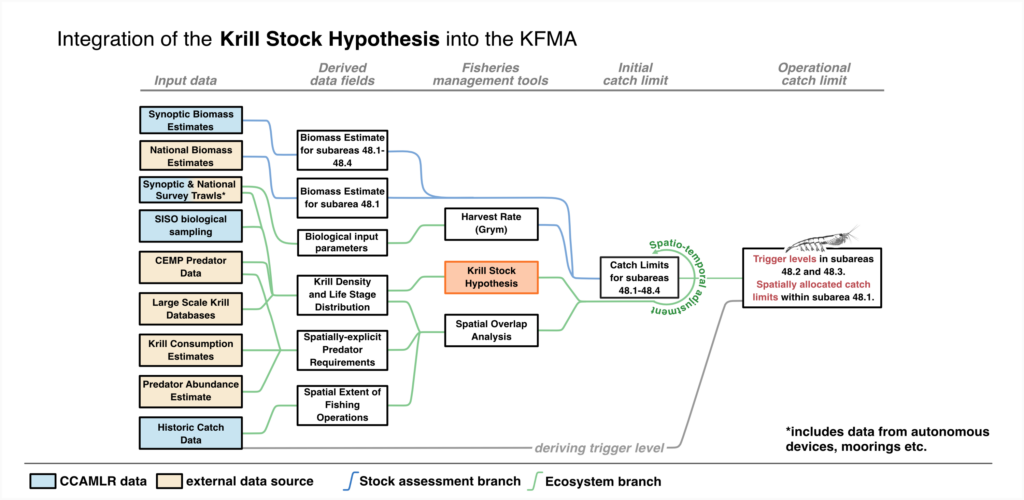
This adaptive approach continuously incorporates ecological data on krill and their predators, providing the scientific foundation for spatially allocated catch limits informed by ecosystem monitoring. The Scientific Committee also endorsed enhancing the Ecosystem Monitoring Programme (CEMP) as integral to this framework.
While management reforms remain elusive, the endorsement of KSH establishes the ecological and scientific basis needed to guide future decision-making, a crucial step toward sustainable management in a rapidly changing Southern Ocean.
Why this matters
SKEG members’ research on krill biology, population dynamics, ecosystem interactions, and climate impacts directly shaped this new management framework. Members’ work on krill life cycles, spawning areas, predator interactions, and acoustic surveys provides the foundation that makes the KSH possible.
By translating scientific understanding into policy-relevant frameworks, SKEG demonstrates how collaborative Antarctic research can drive conservation outcomes.
This endorsement ensures that the collective expertise of our community will continue to inform management decisions affecting Southern Ocean ecosystems.