
REPORT of the online workshop of the SCAR Krill Expert Group, 20-24th March 2023
Organisation committee:
Bettina Meyer; So Kawaguchi; Javier A. Arata; Angus Atkinson; Kim Bernard; Simeon Hill; Steve Parker; Zephyr Sylvester
Pew Host Support:
Nicole Bransome; Nicholas Kirkham
Summary:
The SCAR Krill Expert Group (SKEG) aims to improve the understanding of krill biology and
ecology and serve as a link between the scientific krill community and the Commission for the
Conservation of Antarctic Marine Living Resources (CCAMLR), which manages the Antarctic krill
fishery. SKEG also provides a platform for research direction, information exchange, and collaboration
within the krill community, with a focus on early career researchers (ECRs). The 2023 SKEG annual
workshop was held virtually over five days in March 2023, with 83 participants from 13 countries,
including ECRs. The number of participants provided a sufficient sample size for polling questions to
support CCAMLR in the process of developing a KSH for their revised krill fishery management
approach. Its focal topic was the development of a Krill Stock Hypothesis for CCAMLR Area 48. The
current document serves as a record of the workshop and a report to CCAMLR’s working group on
Ecosystem Monitoring and Management (WG-EMM) which is tasked with developing advice on krill
fishery management.
The workshop developed a preliminary KSH and identified key data requirements to support further
refinement of the KSH. These include more data on krill length distributions, standardized test hauls,
and information on egg and larvae distribution, recruitment locations, and year-class strength. Several
recommendations were made for WG-EMM, including reviewing and recommending the Krill Stock
Hypothesis (KSH) as a tool for managing the krill fishery, to identify critical aspects of the KSH that need
testing, considering ways to collect necessary information, and to identify data which can be collected
by krill fishing vessels or scientific observers. These recommendations aim to develop robust
management options for the krill fishery, including more data on krill length distributions, standardized
test hauls, and information on egg and larvae distribution, recruitment locations, and year-class strength.
download the full report (including all figures and appendices)
Background
In 2019, the CCAMLR endorsed a strategy to develop a sound science-based management approach for krill in Subareas 48.1, 48.2, 48.3, and 48.4. The revised krill management approach comprises (i) a stock assessment to estimate precautionary harvest rates; (ii) a regularly updated biomass estimates, initially at the subarea scale, but potentially at multiple scales; and (iii) a spatial overlap analysis to inform the spatial allocation of catch (previously known as risk assessment) (see Figure 1).
While considerable data has been collected for Subarea 48.1, far less data is available for Subareas 48.2, 48.3, and 48.4 and many areas lack wintertime data. Therefore, the SC-CAMLR agreed to prioritise the development of management advice for Subarea 48.1 acknowledging other Subareas will take longer (SC-CAMLR-40 Annex 6 paragraph 2.66).
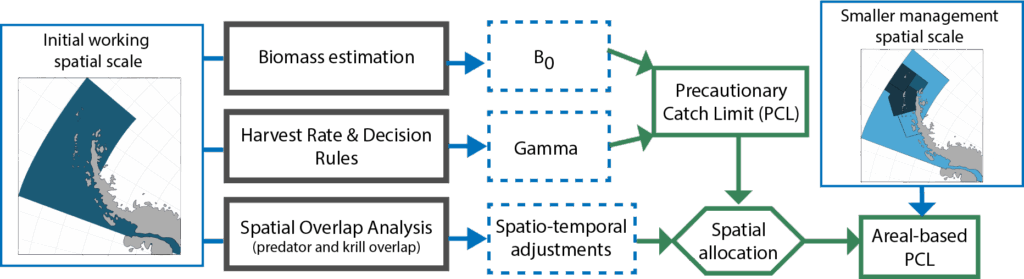
SC-CAMLR-40, Annex 8, Figure 1)
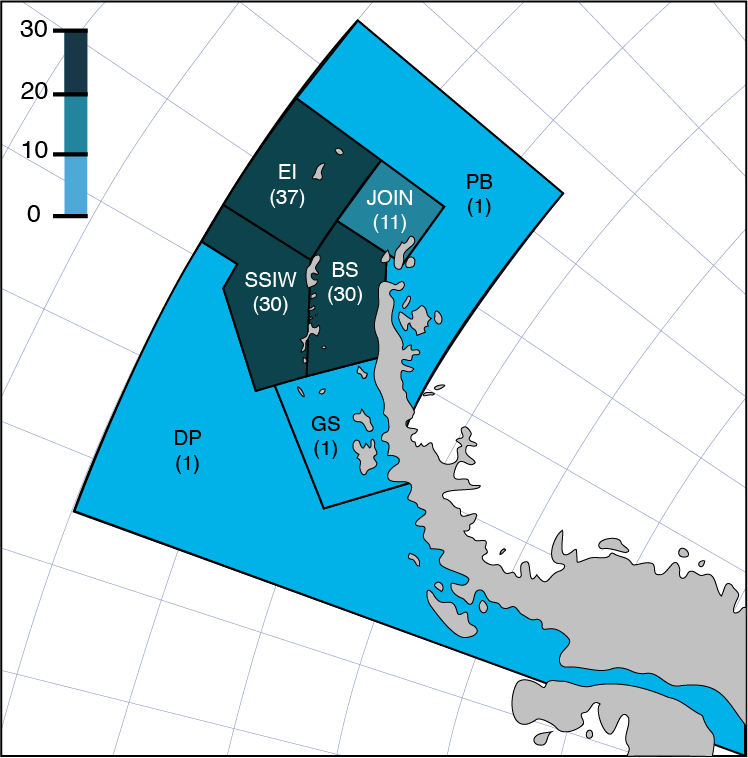
strata. The strata were shaded and labeled
according to the number of acoustic surveys
conducted in each stratum from all available
years 1996–2020. EI: Elephant Island, JOIN:
Joinville, BS: Bransfield Strait, SSIW: South
Shetland Islands West, GS: Gerlache Strait,
DP: Drake Passage, PB: Powell Basin. Adapted
from SC-CAMLR-41, Annex 5.
In 2022, the CCAMLR Scientific Committee agreed that proposed revisions to precautionary catch limits (PCL) for Antarctic krill are consistent with the agreed
CCAMLR decision rules for krill and based on best available science (SC-CAMLR-41 Report Paragraph 3.46 and Table 2) in Subarea 48.1 (totaling 668,101 tonnes for 2022/23) and its subdivision into smaller management strata (Figure 2).
The Scientific Committee also noted that this represents a substantial increase in catch limits, if implemented, compared with the historical catches for some strata. They recommended to the Commission that implementation of increases in catch limits should be staged and occur in conjunction with additional research e. g. increased survey frequency. This would ensure that increases in harvesting are accompanied by an increased collection of data to monitor catches, by-catch, and the impact on the wider ecosystem (SC-CAMLR paragraph 3.48). However, no consensus was achieved on the implementation of the revised catch limits. Further, it was noted that interactions between the subareas, due to the flow of krill between areas (flux), need to be investigated (SC-CAMLR-41 Annex 9 Paragraph 7.37).
In this context, the Scientific Committee requested the establishment of a krill stock hypothesis (KSH), to provide a framework for interpreting patterns observed in survey and fishery data, and provide a crucial tool to direct surveys and analytical efforts to progress discussion toward a holistic means of implementing the revised management approach (SC-CAMLR paragraph 3.26).
During CCAMLR’s annual meetings in November 2022, it became clear that developing a KSH, one of the core elements of CCAMLR’s krill management work plan, could not be achieved without external scientific support. SKEG was therefore tasked by both the Commission and the SC-CAMLR to help develop a working stock
hypothesis for krill in Area 48 based on the best available science and to submit a report for consideration by the Working Group on Ecosystem Monitoring and Management (WG-EMM) in July 2023 (SC-CAMLR paragraphs 3.26-3.29). As a result, SKEG held a workshop as a series of five Webex meetings from 20 to 24 March 2023, each of 3 hours. The main aim of the workshop was to start developing a working draft KSH that captures the spatial and temporal dynamics of the stock in Area 48, in the southwestern Atlantic sector of the Southern Ocean, to support CCAMLR in this process.
For the purposes of the current report a krill stock hypothesis (KSH) is defined as a conceptual model of the biology of the krill population (stock) dynamics with respect to spawning, recruitment, vertical and horizontal movement, and
connectivity (immigration and emigration) between regions. The development of a comprehensive KSH can be used to define the appropriate size of fishery management units and, in combination with biomass estimates, harvest rates in such a way that the stock and the predators depending on it would not be adversely affected.
Workshop Proceedings
To accomplish the aims of the workshop, the SKEG board developed a workshop composed of a series of background talks, guided discussions, a series of surveys conducted before, during and after the workshop, and a day focused on emerging science and early career researchers.
Prior to the workshop an online “Map Survey” of CCAMLR Areas 48.1 – 48.4 was conducted to get expert opinions on the current knowledge on the locations on essential aspects of a KSH, such as spawning hotspots, nursery hotspots, adult krill hotspots in summer and adult hotspots in autumn/winter. We provided a link to those registering before the WS started. Each participant could show where they thought hotspots of krill spawning and nursery areas were located as well as hotspots of adult krill in summer and autumn/winter. Participants were shown a map of the Atlantic sector of the Southern Ocean with CCAMLR Areas 48.1-48.4 (Fig. 3), and could select the grid cells where they thought hotspots were for each life stage and season. Results were automatically sent to the Project Management Office (PMO) at Computing and Data Centre at AWI. They created the survey and analysed the results.
On the first day, a series of presentations were given to provide participants with an overview of why it is necessary within CCAMLR to develop a KSH (So Kawaguchi) and what is meant by the term krill stock hypothesis, by outlining the example for toothfish (Phil Ziegler). Following these talks, the current knowledge pertinent for developing a KSH was presented in four specific talks: (1) the main drivers of krill habitat in the Peninsula and Scotia Arc region (Christian Reiss), (2) seasonal krill dynamic, spawning grounds (hotspots) and potential areas they replenish (Angus Atkinson), (3) krill recruitment shifts in time and space (Taro Ichii) and (4) recruitment dynamics via model approaches (Alexey Ryabov).
Following a summary of the contextual information provided on the first day, workshop participants gave their thoughts regarding the process of developing a KSH in a recorded survey on the second day. A guided discussion then addressed which knowledge gaps exist that are specific to developing a KSH and how the gaps can be filled most effectively. To establish the expert opinion of the current krill research community on how to collect the missing data and how to develop a KSH, the discussion was followed by another participant survey on existing knowledge gaps and how to fill them. On the third day, with the information in hand from the first day and the knowledge gaps identified during the second day, the most important gaps required to take action were identified. With the help of further polling questions and discussions, an action plan outlining a strategy for developing a KSH in the upcoming years was identified.
The fourth day was dedicated to showcasing ongoing science related to the development of a KSH by Early Career Researchers (ECRs). Dr. Ari Friedlander delivered a keynote address entitled, “Towards a better understanding of the ecological relationship between whales and krill around the Antarctic Peninsula”. The 12 ECR-led talks that followed presented a wide variety of research approaches.
The meeting closed with a recap of the discussions from the previous days and announcements of upcoming events and meetings involving SKEG.
The number of participants at the daily sessions (19:00-21:00 UTC) averaged about 83 at any one time and were from around the world (UK, Australia, China, USA, Korea, Ecuador, Argentina, Germany Norway, Canada, Japan, Netherlands, and Belgium, respectively) of which about ~24% were Early Career Researchers (ECRs). This online workshop included sufficient participation to represent the weight of the expert opinion of the current krill research community. Additionally, the number of participants provided a sufficient sample size for polling questions to support CCAMLR in the process of developing a KSH for their revised krill fishery management approach. What follows are the main results from the polls and discussions from the workshop.
Workshop Results: Development of a Krill Stock Hypothesis
Pre-workshop Survey
A series of polling questions were submitted to the attendees prior to and during the workshop to get expert opinions from the SKEG community to develop an action plan on the next steps within the process of developing a KSH. The full list of questions is presented in Appendix 1.
Prior to the workshop, we performed a “Map Survey” of CCAMLR Areas 48.1 – 48.4 to get expert opinion on the current knowledge of the locations of essential aspects of a KSH, such as spawning hotspots, nursery hotspots, recruitment hotspots, adult krill hotspots in summer, and adult hotspots in autumn/winter. Of the 83 participants, 32 workshop attendees participated in the “Map Survey” before the start of the workshop.
According to expert opinion, the distribution of adult krill during summer mirrors the location of krill spawning hotspots (Fig. 4d and a), whereas the entire area 48.1 and 48.2 are seen as krill nursery areas (Fig. 4b). The tip of the Antarctic Peninsula is suggested to be the main recruitment hotspot, as well as the entire shelf region of the western Antarctic Peninsula (WAP) and the area around the South Orkney Islands (Fig. 4c). In autumn and winter the adult population is concentrated mainly over the continental shelf along the WAP, the tip of the Antarctic Peninsula and South Georgia Island (Fig. 4e).
1 ) What do we know and where are our knowledge (data) gaps in developing a KSH?
The following is a summary of the existing knowledge on the understanding of environmental drivers, connectivity, krill demography, and modeling. A visual summary is provided in Figure 5, which describes some of the messages in the four initial presentations on the first workshop day that examine the spatial-temporal distribution of krill in the context of the KSH.
Regarding environmental drivers, it has been established that changes in the environment over time have a significant impact on krill dynamics, particularly in terms of recruitment. Dr. Christian Reiss provided valuable insights into how environmental factors and climatology influence these dynamics. Connecting the dots from environmental drivers towards connectivity, Dr. Taro Ichii’s research highlights that we can start to understand how climate change can impact spatial connections. And when it comes to spatial connectivity, Dr. Angus Atkinson illustrated that we have a basic spatial and seasonal understanding of where life stages are distributed in area 48.1. Additionally, Dr. Alex Ryabov and collaborators have developed models that allow us to test our understanding and hypotheses about spawning-recruitment dynamics in relation to environmental drivers and climate change, as well as connectivity between regions.
2) Expert Opinion on developing a KSH (Polling Results)
The polling results performed during the workshop provide useful insights about the research required to develop an effective KSH and identify the main data gaps. Overall, the experts’ collective opinion was that understanding the connectivity between hotspots, as well as horizontal and vertical migration, is important for developing an effective KSH. These factors were also identified as the key knowledge gap. Further, research that will provide a mechanistic understanding of the interaction between sea-ice dynamics and krill life history parameters, the effects of climatic indices, and the effects of variability in habitat conditions on production and recruitment will help improve and refine the KSH.
A series of questions were asked about aspects regarding life stage hotspots for developing the KSH. All polling questions and results can be found in Appendix I. Participants were asked to identify important aspects that define life stage “hotspots” for each life stage (Figure 6). After identifying which aspects were important, participants were then asked which data gaps for each aspect were the most significant for developing a KSH (Figure 7).
Across all life stages (spawning, larval, recruitment, and juvenile), hotspot location and connectivity were identified as the most important aspects for developing KSH. Connectivity for all life-stage hotspots was the highest-ranking data gap, followed by permanence. This result implies that the experts’ general opinion is that understanding connectivity and pathways between life-stage hotspots is important and, at the same time, remains a major knowledge gap.
The dynamic spatial distribution for the development of the KSH was assessed in a question regarding the additional dynamic spatial distribution of krill life stages. Participants were asked which aspects needed to be determined in order to develop a KSH (Figure 8)
The role of continental vs oceanic components of the krill population, followed by variability in recruitment, were identified as important dynamic spatial distribution aspects for the KSH. Both, timing of growth and movement between hotspots and the role of continental vs oceanic components of the population were identified as important knowledge gaps.
Participants were polled to identify the key needs for developing an effective KSH by ranking the importance of a series of seven statements (see Appendix I). Participants were generally in agreement with all seven statements in Question 9 (Figure 9). However, four of the statements stood out as being of unanimously high importance. These were ‘identification of life stage hotspots’, ‘understanding connectivity’, ‘interaction of horizontal and vertical migration’, and ‘the effects of climate variability and change on recruitment’.
This question was followed by a question asking participants to rank a series of five statements on the development of specific elements of a KSH (Figure 10). The participants were in general agreement with all five statements in Question 10, but ‘development of the mechanistic relationship between sea ice characteristics’ and ‘krill life history parameters’ showed strongest agreement, with a slightly weaker agreement for the need for ‘development of data-driven stock-recruitment model’ and ‘spatially explicit year-round model for female distribution and abundance’.
Habitat quality of nursery grounds, sea-ice coverage in winter, and timing of seasonal phytoplankton blooms were considered generally important as the main drivers of the variability in recruitment. Factors impacting the progression of calyptopis-3 to juveniles were considered as the main unknown about the control of krill recruitment and also likely the most variable between years (Questions 11-13).
Participants identified the importance of various elements that impact each phase relating to reproduction and recruitment (egg output, progression from egg to calyptopis-3, progression from C3 to juveniles, and lipid accumulation during the adult phase). Egg output was largely impacted by female abundance, condition (including lipid accumulation), and food availability. Once hatched out and until the calyptopis-3 stage, climatic indices and habitat quality, and nursery grounds were identified as important elements. From calyptopis-3 to juvenile, the seasonal cycle of primary productivity (i.e. timing of the spring bloom) and sea ice were considered important. Lipid accumulation during the adult phase was considered primarily impacted by the timing of primary productivity and summer-winter habitat condition (Figure 11).
Lastly, the poll results regarding our action plan identified a 5 to 10-year time span as the most realistic timeframe to refine a KSH. For fieldwork, the identified goal was to develop a unified plan in which we address specific research priorities to close data gaps such as the seasonality of growth and movement between hotspots, understanding the a) role between continental vs oceanic physical components, b) the drivers of the inter-annual variability of krill productivity (including climate change) as well as c) the drivers of horizontal and vertical krill migration. To address these research priorities, the poll results further showed that we have to use, in a complementary manner, different data collection platforms and approaches, such as:
- Data from autonomous vehicles such as from gliders and moorings (i.e., US-AMLR program);
- Krill fishing vessels on which trained scientific observers and quality/control people collect needed data from the catch.
- Mining and compiling existing data, to identify data gaps or improve our understanding of processes.
- Model development (spatial life cycle model, stage-specific distribution, or the krill stock, mechanistic relationship between sea ice and recruitment, Climate change impact on krill population across life stages)
3) The contribution of Science Day to developing a KSH
Science Day focused on the ongoing research related to the development of a KSH by Early Career Researchers (ECRs). Dr. Ari Friedlander gave a keynote address, providing insights into the ecological relationship between whales and krill around the Antarctic Peninsula. His talk was titled, “Towards a better understanding of the ecological relationship between Whales and Krill around the Antarctic Peninsula”. The talk was an example of how important the bridge between whale-specific research and krill-specific research is. Following the keynote talk, a series of twelve presentations were given by early career researchers on their recent and ongoing research, which could contribute to developing a KSH, inform the development of a KSH, or be adapted to the development of a KSH. The research presented covered a wide variety of topics (see appendix II for a list of talks) while sharing a common focus on understanding and modeling the ecological dynamics of krill and its role in the Southern Ocean ecosystem. Key themes that emerged from the talks included the estimation of krill and whale abundance in fishing regions, the seasonality and plasticity of krill migration behavior, the impact of endogenous clocks on krill processes, the ecosystem effects of krill fisheries, and the modeling of krill biomass distribution and energy budgets. Other topics included habitat connectivity, reproductive dynamics, diet comparisons, and spatiotemporal trends in fishing and natural mortality. Together, the series of talks highlighted the important role of early career researchers in advancing the development of a KSH and improving the management of krill fisheries and habitats in the Southern Ocean.
Ultimately the day energized participants by showcasing exciting new research approaches and impressive footage from the field. The day encouraged participants to think critically about how to capture the spatial and temporal dynamics of the krill stock for better management of the krill fishery and krill habitat. Overall, it contributed significantly to the development of a KSH by presenting a wide range of research approaches that could help inform or be adapted to the KSH. It also highlighted the importance of collaboration between different disciplines and levels of experience in krill research.
4) Working Draft of a Krill Stock Hypothesis (KSH)
The following KSH, as summarized in figure 12, was developed during the workshop from the current knowledge we have on krill for subareas 48.1 and 48.2, workshop discussions, and polling results. Recalling that the ideal purpose of a KSH is to serve as a model for evaluating management strategies for the krill fishery and for facilitating research on the structure of krill populations, this KSH is a working hypothesis meant to be re-evaluated and updated as new insights arise. The key processes represented in the KSH are:
- Localised migration loops (spawning-recruitment complexes, SRCs) in which adults spawn in deep shelf-adjacent waters and larvae migrate inshore to complete development, often in association with sea ice. The adult population is concentrated in shelf and shelf-adjacent areas with the shelf population actively migrating to spawning areas.
- Regional-scale larval flux in which larvae are transported on ocean currents to sites away from their natal migration loops, thereby enhancing recruitment in other areas, and possibly contributing to recruitment periodicity
- Regional-scale post-larval flux in which individuals move away from their natal migration loops through a combination of transport on ocean currents and active behaviour, thereby enhancing biomass in other areas (not shown in Figure 12).
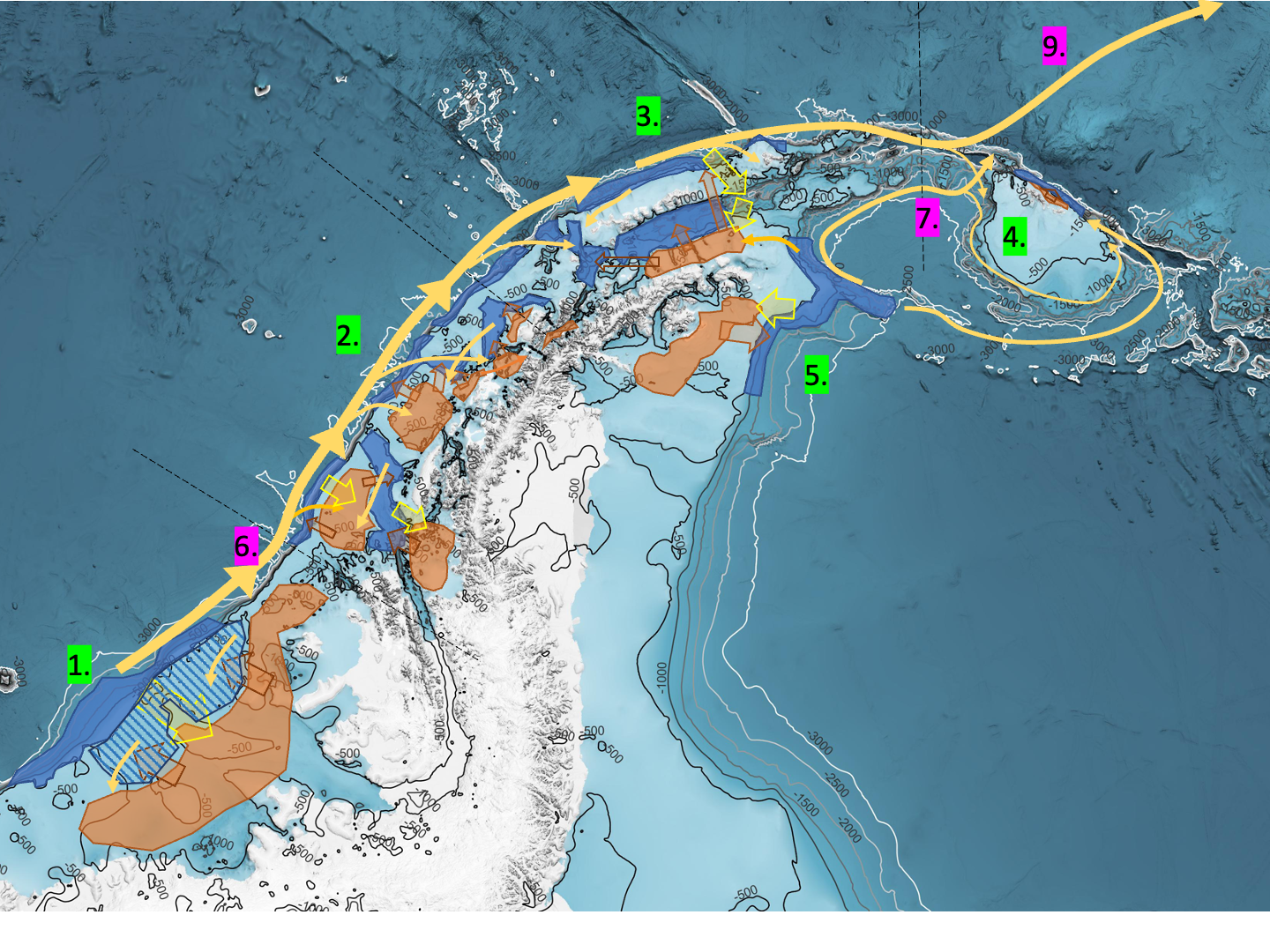
The figure outlines the following hypotheses regarding krill populations:
- A significant spawning population in the Bellingshausen area is suggested [1], which would provide recruits downstream along the Antarctic Peninsula [6], and could replenish the krill population in the NAP region.
- Another spawning population is suggested to exist in the NW Weddell Sea [5], which supplies recruits into the Bransfield Strait and the South Orkney region.
- Alternatively, the NAP region could potentially have a mainly self-sustaining population, thanks to the retention of recruits in the Bransfield Strait [3], with some immigration from WAP and the Weddell Sea [6,8]. Furthermore, it is suggested that the South Orkney region would receive recruits from both the NAP and NW Weddell Sea regions [4].
- Additionally, a self-sustaining population at Marguerite Bay was also suggested [2].
- The South Orkney and wider Scotia Sea regions would receive recruits from both the NAP and NW Weddell Sea regions [7,9].
In relation to the first draft of a KSH (Figure 12), it must be pointed out that there was considerable uncertainty about whether krill spawn inshore of the shelf break as suggested by Frances Perry, unpublished PhD work, or in oceanic water, which is the existing paradigm.
Recommendations for the CCAMLR working group Ecosystem Monitoring and Management (WG-EMM)
With this workshop, SKEG aimed to develop the first iteration of a KSH that would evolve as understanding improves. At the start, we developed a KSH based on what is known in terms of expert opinion and existing literature. The KSH will be updated by identifying priority research and gaps that need to be filled.
The results and discussions at the SKEG workshop in 2023 have led to the following recommendations for WG-EMM, including data collection needs from krill vessels and krill observers for consideration at the Krill Fishery Observer workshop (WS-KFO-2023):
1) That WG-EMM should review the KSH developed by the workshop and recommends it to the Scientific Committee as a tool to assist in developing plans for managing the krill fishery.
2) That WG-EMM identifies critical parts of the overall KSH that need to be tested to develop robust management options given the associated uncertainty.
3) That WG-EMM should consider how the information required can be collected to test components of the KSH, especially those aspects that are spatially or temporally detached/disconnected from the fishery, such as the abundance and distribution of krill in the Bellingshausen and Weddell Seas, winter distribution and abundance in Subarea 48.1, and the role of inshore areas and deep water in the life cycle of krill.
4) That WG-EMM should identify data that support testing and further development of the KSH to be collected by krill fishing vessels, or by scientific observers on board krill fishing vessels. These may include more data on krill length distributions in the catch segregated by month and management strata, standardized test hauls to collect samples, and data on egg and larvae distribution, recruitment locations, and year-class strength.
Acknowledgements
The online workshop was hosted by the Pew Charitable Trusts, and we are grateful for the support of Nicole Bransome and Nicholas Kirkham for the smooth running of the event, AA’s contribution was supported by the European Space Agency’s BOOMS (Biodiversity in the Open Ocean: Mapping, monitoring and modeling) project.