

PREDator responses to seasonal
krill dYnamiC and krill fishing activiTies
Upcoming · Friday 14 August 2026 · Oslo
First joint PREDYCT + ECOSENT workshop at the SCAR Open Science Conference
14:00–15:30 and 16:00–17:30.
Where field methods, data standards, and international coordination for the 2026/27–2028/29 field seasons get set.
Clarion Hotel The Hub, Floor 1 – Prado Park
Why PREDYCT, why now
Austral summer 2027 is when the implementation of Antarctica InSync begins. InSync is an international initiative to synchronise observations, and to quantify and analyse rapid environmental and ecosystem change around and across Antarctica.
The southwestern Atlantic sector of the Southern Ocean is a global ecological hotspot. It supports some of the densest populations of Antarctic krill (Euphausia superba) on Earth, and the penguins, seals, and whales that depend on them. It is also one of the fastest-warming regions on the planet, and the location of a rapidly expanding krill fishery that has set consecutive catch records in recent seasons.
The Commission for the Conservation of Antarctic Marine Living Resources (CCAMLR) manages this fishery under a mandate requiring ecosystem-based, precautionary management. Delivering on that mandate requires integrated evidence that no single research group can generate alone on across predators, prey, fisheries, and the environment.
PREDYCT is that integration.
What PREDYCT does
Four objectives, addressed in coordination across three austral summer field seasons (2026/27 – 2028/29).
1 · Overlap in space and time
Quantify how, where and when krill predators and krill fisheries share space, and test how overlap shapes predator behaviour.
2 · Behavioural interactions
Investigate whether local and remote fishing activity alters predator foraging, movement, and energetic costs.
3 · Standardised monitoring
Align predator biologging, krill acoustic surveys, and fisheries observations into a single interoperable, multi-platform framework.
4 · Inclusive collaboration
Build a durable international science community to sustain this work beyond any single project cycle and across career stages, genders, disciplines, and nations.
Working Groups
The science is delivered by four thematic groups working in parallel, each contributing to the shared objectives from a different angle. After data collection, the different data streams will be integrated in a joint synthesis effort.
Krill
Regional krill biomass, swarm dynamics, and seasonal krill flux across Subareas 48.1 and 48.2 using calibrated echosounders on research vessels, gliders, moorings, and fishery platforms.
Baleen whales
Humpback, fin, and other whale distribution and behaviour: visual surveys from research vessels, platforms of opportunity, aerial line transects, UAS photogrammetry, biopsy sampling, satellite telemetry, and moored passive acoustics.
Penguins
Pygoscelis penguin foraging and post-breeding dispersal via accelerometry and biologging at colonies along the WAP and Scotia Sea, satellite telemetry, and Starlink-connected remote cameras at Monroe and Signy Islands.
Seals
Antarctic fur seals with SPLASH 10 biologging at Cape Shirreff (Livingston Island), and Crabeater seals with SCOUT-DSA accelerometer tags during the KrillBIS expedition, plus isotopic diet analysis.
Where the work happens
PREDYCT fieldwork is concentrated in CCAMLR Subareas 48.1 (Antarctic Peninsula) and 48.2 (South Orkney Islands). Coordinated activities across three austral summer seasons integrate multiple platforms and international partners.
The following map shows the planned PREDYCT field activities across CCAMLR Subareas 48.1 and 48.2, 2026/27 – 2028/29 field seasons.
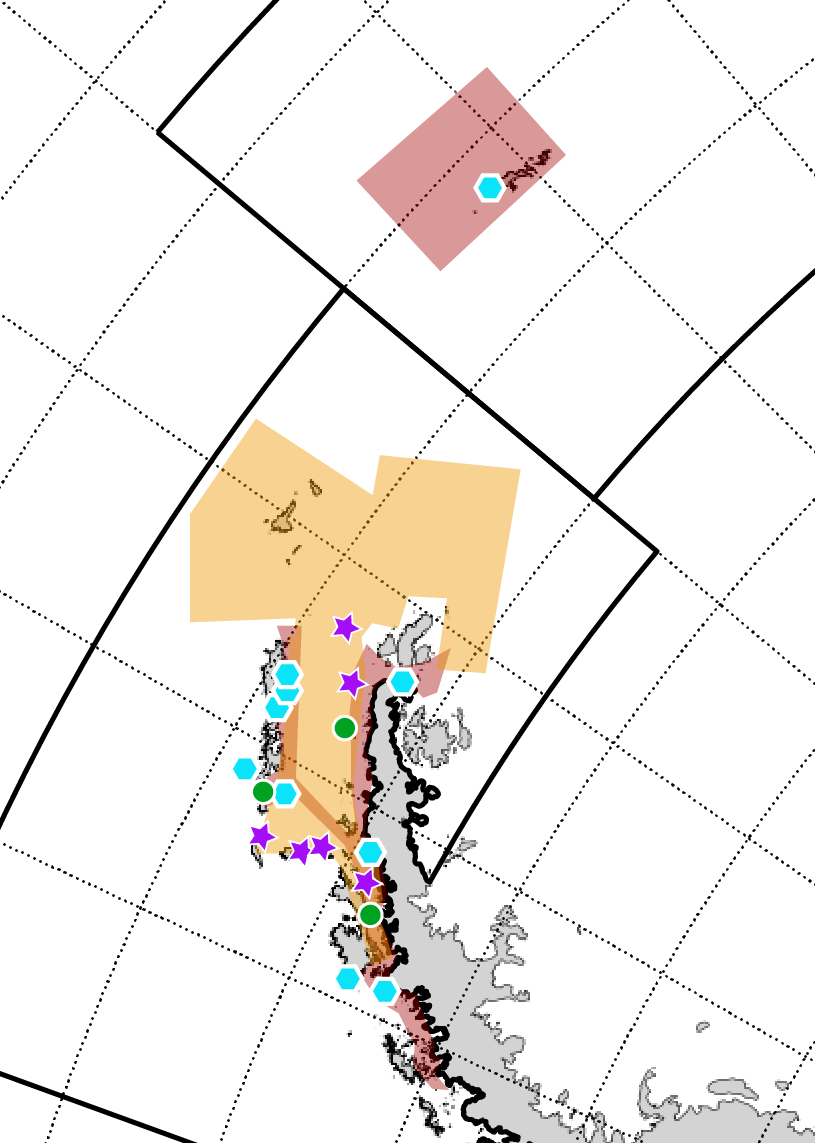
Overview of proposed observing activities across the Scotia Sea and Antarctic Peninsula region. Activities are grouped by observing platform: krill survey areas are indicated by orange polygons; whale surveys areas are indicated with red polygons; seal tagging locations are shown as green circles; penguin survey locations are shown as blue hexagons; multifunctional mooring locations are shown as purple stars.
Anchor campaigns
KrillBIS PS159 — RV Polarstern, Feb–Apr 2027. Coordinated krill acoustic surveys, cetacean aerial line transects, crabeater seal biologging and deployment of four ecological moorings in Subarea 48.1.
Peruvian krill surveys — BAP Carrasco, Dec–Jan 2027–2029. Regional krill biomass survey in Subarea 48.1.
Norwegian survey — CV Antarctic Provider, February each year. South Orkneys (Subarea 48.2), coordinated krill biomass surveys, deployment of moored combined ADCP/ecosounders NW of Coronation Island.
ARK partnership — semi-annual krill surveys aboard fishing vessels and acoustic data extraction for predator dive behaviour across the fishing seasons.
USA moored array and gliders — moored ADCPs and echosounders in the Bransfield Strait, plus ballast-glider surveys in Subarea 48.1 for year-round krill distribution and flux.
FINTRACK 2028 — RV Maria S. Merian expedition for fin whale tagging and diet sampling in Subareas 48.1 and 48.2.
PREDYCT operates in close cooperation with the Antarctica InSync ECOSENT working group on ecosystem sentinels.
Timeline
Plan
jun 2025 – oct 2026
Online coordination meetings and the first joint workshop with ECOSENT at the SCAR Open Science Conference to align field methods, data standards, funding, and training.
Collect
Nov 2026 – Feb 2029
Three coordinated austral summer field campaigns: land-based penguin biologging, ship- and vessel-based krill acoustic surveys, moored systems, and predator tagging.
Deliver
2030 onward
Synthesis, Mechanistic modelling integrating environmental parameters, and delivery of results to CCAMLR, SCAR, and the peer-reviewed literature.
Who’s doing the work
Convenors
Bettina Meyer
Alfred Wegener Institute & University of Oldenburg (Germany). Co-chair, SCAR Krill Expert Group. Scientific representative of the German delegation to CCAMLR. Krill biology, physiology, and fishery management.
Andrew Lowther
Norwegian Polar Institute. Predator spatial ecology and marine spatial planning in the South Orkney krill hotspot. Long-standing participation in CCAMLR scientific and policy meetings.
Álvaro Soutullo
Universidad de la República (Uruguay). Secretary-General of the Uruguayan Antarctic Institute. National representative to COMNAP. Applied and behavioural ecology; marine predators as environmental sentinels.
Working Group members (as of now)
Krill Group. Bettina Meyer (AWI, Germany), Dominik Bahlburg (AWI / IMR / UW), Javier Arata (ARK), Bjørn A. Krafft (IMR, Norway), Douglas Krause (NOAA AMLR, USA), Rubén Pablo Londoñe Bailon (Peruvian Antarctic Programme), Francisco Santa Cruz (INACH, Chile), Xinliang Wang (YSFRI, China), Yi-Ping Ying (YSFRI, China).
Baleen Whale Group. Angus Henderson (University of Tasmania), Ari Friedlander (UC Santa Cruz), Helena Herr (AWI / University of Hamburg), Elling Deehr Johannessen (Norwegian Polar Institute), Heidi Ahonen (Norwegian Polar Institute), Ilse van Opzeeland (AWI), Ryan Reisinger (University of Southampton).
Penguin Group. Álvaro Soutullo (UdelaR, Uruguay), Mercedes Santos (IAA, Argentina), Andrew Lowther (Norwegian Polar Institute), Jefferson Hinke (NOAA AMLR, USA), Lucas Krüger (INACH, Chile), Francisco Santa Cruz (INACH), Victoria Warwick-Evans (British Antarctic Survey), Jeong-Hoon Kim (KOPRI, Korea), Virginia Morandini (EBD-CSIC, Spain), Megan Cimino (UC Santa Cruz), Bettina Meyer (AWI), Dominik Bahlburg (AWI / IMR / UW).
Seal Group. Andrew Lowther (Norwegian Polar Institute), Sara Labrousse (Sorbonne University, France), Douglas Krause (NOAA AMLR, USA).
.PREDYCT also partners with CCAMLR, SCAR (including SKEG and BAMM), the Association of Responsible Krill harvesting companies (ARK), the InSync ECOSENT working group, and NGO partners including Oceanites and HUBOcean. If you want to contribute to PREDYCT, please get in touch with us!
Learn more
PREDYCT will advance method development, data integration and provide direct advice for CCAMLR’s Krill Fisheries Management Approach (KFMA).
Project links
- PREDYCT white paper (Antarctica InSync)
- ECOSENT — sister InSync Working Group
- The Antarctica InSync programme
- SCAR Open Science Conference 2026 · Oslo
- Scientific Committee on Antarctic Research (SCAR)
- CCAMLR — Commission for the Conservation of Antarctic Marine Living Resources
Key references
- Meyer et al. 2025 — Adjusting krill fishery management for the 21st century (PNAS)
- Kawaguchi et al. 2024 — Climate change impacts on Antarctic krill (Nature Reviews Earth & Environment)
CCAMLR working papers
- WG-EMM-2024/21 — Bahlburg et al. Mapping encounters between krill fishing vessels and air-breathing predators using acoustic data from the fishery (published version).
- WG-EMM-2024/55 — Reiss et al. Seasonal variability in transport of krill-like scattering into Bransfield Strait, resolved from an array of echosounders (related publication).
- WG-EMM-2024/56 — Henderson et al. Cost-effective cetacean abundance and distribution estimates using data collected from tourist vessels (related publication).
- WG-EMM-25/43 — Johannessen et al. Integrating cetacean research into the CCAMLR Ecosystem Monitoring Program and the revised KFMA.
- WG-EMM-26/22 — Meyer & Bahlburg. Krill stock assessment in CCAMLR area 48.1 — KrillBIS PS159 expedition plan.
Stay in touch
Follow PREDYCT progress and join the working-group mailing list for updates on workshops, field seasons, and outputs.